

54% of surveyed enterprises identified moving data without disrupting users and applications as their top technical unstructured-data management challenge, according to Komprise's 2024 survey of 300 global enterprise IT and business decision-makers. That reframes the job. Moving records is only part of migration; keeping the organization operating is the harder commitment.
Enterprise data migration programs need to control business continuity, delivery cost and future operating flexibility alongside data integrity. A technically successful load means little if finance can't reconcile balances, warehouse teams can't release orders or the target architecture makes every subsequent transfer expensive. Build the program around evidence, named decision-makers and explicit limits on disruption.
Table of Contents
- Program Phases and Exit Gates at a Glance
- How to Profile Data and Baseline the Program
- Choosing Lift-and-Shift, Replatforming or Refactoring
- Confirm the Baseline Before You Commit a Cutover Date
- Validating Every Batch Before the Next One Moves
- Cutover, Rollback and Running the Business Through Migration
- Success Metrics and Governance Gates That Prove Readiness
Program Phases and Exit Gates at a Glance
A migration can finish technically and still miss its business outcome. Each phase therefore needs an output someone can inspect, an acceptance condition they can measure and an owner who can refuse to proceed.
Establish decision rights before delivery starts. The program sponsor controls budget release; the steering committee meets at each gate and records its decision; the program director controls scope and change requests. Use a RACI matrix to distinguish who performs the work, who approves it and who must be consulted.
Migration phases, outputs and exit gates
| Phase | Core output | Exit gate | Accountable owner |
|---|---|---|---|
| Discovery | System inventory and data ownership map | Every source system has a named business owner | Program sponsor |
| Profiling | Baseline counts, null rates and duplicate reports | Data owners have signed off the profiling report | Data architect |
| Strategy | Target data model and approach per dataset | Approach is approved against documented cost and risk criteria | Program director |
| Build and transform | Mappings and transformation code in a test environment | Mappings have been reviewed against the target model | Data engineering lead |
| Test and validate | Batch reconciliation results | Control totals match within agreed tolerance | QA lead, with business-owner approval |
| Cutover and rollback | Runbook, rehearsal log and rollback thresholds | Mock cutover completes inside its approved window | Cutover manager |
| Reconcile and stabilize | Post-migration reconciliation report | Business sign-off is recorded and exceptions are closed | Named business owner, supported by the support team |
The final row must name an individual business owner in the actual RACI. A department or support queue can contribute, but neither should carry ambiguous accountability for accepting the migrated dataset.
Make the gates enforceable
Record who can approve a scope change, move the cutover date and order rollback. Those decisions shouldn't default to whoever is available during a production incident. Give each decision-maker a deputy and make escalation routes part of the program charter.
A gate review should contain the output, acceptance evidence, unresolved issues and the owner's recommendation. If the steering committee accepts a residual risk, record its business consequence, compensating control and expiry condition rather than marking the issue resolved.
Practical rule: A missing signature is an unpassed gate, not implied approval.
The gates are sequential approvals, even when teams prepare later work in parallel. Failed profiling acceptance should block commitment to the affected design; failed validation should block production release. The sponsor signs this phase agreement before releasing delivery budget, so the team isn't negotiating acceptance standards after spending the money.
How to Profile Data and Baseline the Program
Profile actual contents before estimating effort. A Bloor Research survey cited in Zinstall's review of migration failure rates found that 68% of projects were delivered on schedule when organizations profiled before estimating, compared with 55% when they didn't. That's an association, not a guarantee, but it supports a practical ordering decision: inspect first, commit second.
Build a baseline from the source
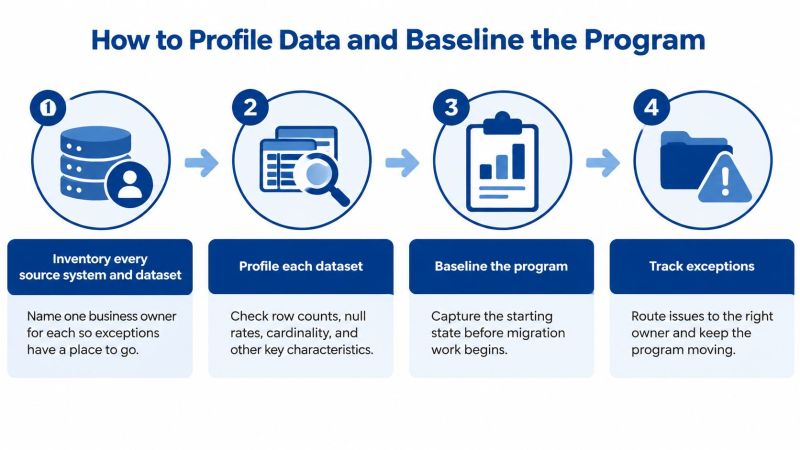
Inventory every system and dataset. Name a business owner who can resolve meaning, retention and correction questions, not merely the administrator who can grant access. Include interfaces, extracts and spreadsheets that business teams use outside the application; omitting them leaves exceptions without a decision-maker.
Profile each dataset's characteristics. Capture row counts, null rates, cardinality, distributions, minimum and maximum values, and referential relationships using SQL queries or a profiling tool. Don't limit coverage to large transactional tables: small customer classifications, material units and status-reference objects can break otherwise sound mappings.
Count defects explicitly. Separate duplicates, invalid codes and undocumented values, then classify them by business consequence. An obsolete description and an unusable payment term require different responses; combining them into a single quality score hides the work.
Rate transformation complexity by object. Inspect custom fields, status codes and extraction logic for embedded business rules, including rules absent from system documentation. A direct field mapping is not equivalent to reconstructing historical account assignments from conditional legacy logic.
Measure remediation capacity. Ask owners to process a representative exception queue and record their actual completion rate alongside normal duties. A schedule built on hypothetical full-time availability won't survive month-end close, stock counts or leave.
Estimate from measured effort. Combine source volumes, transformation complexity, defect workload and available capacity before setting budget and schedule. Carry contingency for remediation, integration dependencies and repeat testing rather than reserving it entirely for infrastructure.
The profiling workflow should make ownership and exception routing visible, not just generate technical reports.
Turn measurements into a delivery commitment
Use the enterprise data quality assessment checklist to structure the assessment conversation. Our assessment can account for source systems, migration priorities, workload design and governance, including how existing SAP environments and wider data platforms shape the target architecture.
For teams exploring automated interpretation of delivery indicators, PlotStudio AI's resource on AI-assisted analysis of development data offers a related analytical perspective. Keep migration acceptance grounded in reproducible queries and owner-reviewed findings, rather than generated summaries alone.
The deliverable is a baseline pack containing volumes, defect rates, transformation assumptions, named owners and a resource-loaded schedule. Preserve the queries and extraction timestamp with it. Otherwise, teams may argue over differences caused by profiling different source states.
Choosing Lift-and-Shift, Replatforming or Refactoring
Choose an approach per dataset, not once for the entire estate. A stable historical archive may need straightforward relocation, while an operational customer model needs redesign. Forcing both through the same method either adds unnecessary work or carries unresolved defects into the target.
Use the strategy comparison to separate platform relocation from changes to business meaning.

Migration approaches compared
| Approach | What changes | Effort and timeline | Main risk | Choose when |
|---|---|---|---|---|
| Lift-and-shift | Data moves with minimal structural change | Lowest effort and fastest for equivalent scope | Carries legacy design and technical debt | The platform exit deadline is fixed and the data model is sound |
| Replatforming | Data model stays, storage or engine changes | Moderate effort, with compatibility testing | Compatibility gaps in queries, types and interfaces | Moving to a managed database or cloud service without redesign |
| Refactoring | Schema and business logic are redesigned | Highest effort and longest test cycle | Scope growth and extended parallel running | Legacy logic or schema causes data quality problems |
Lift-and-shift is a defensible deadline strategy, not automatic modernization. Replatforming requires tests for precision, date handling, collation, query behavior and interface compatibility. Refactoring is justified when retaining the old model would preserve the problem, but it also requires business owners to approve changed meanings.
Price the ability to move again
According to 451 Alliance's discussion of data migration challenges, 72% of surveyed organizations reported being affected by cloud egress charges in 2025, while 39% said those charges prevented a multicloud architecture. Treat outbound movement as an architecture cost, not a procurement footnote.
Build a five-year total cost of mobility model for each shortlisted approach. Include initial extraction and loading, outbound transfer, ongoing replication, temporary dual-running, validation, rollback infrastructure, network redesign, retraining and business interruption. Separate one-time expenditure from recurring charges so a cheap migration doesn't conceal an expensive operating model.
For example, moving an SAP reporting dataset to another cloud may simplify analytics while creating a continuing dependency on cross-cloud refreshes. Compare that design with co-locating processing, reducing transferred history or publishing smaller curated datasets. Each option changes cost, latency and operational responsibility.
Use this video alongside the comparison when discussing migration choices with the delivery team.
Test the economics against data growth, cross-region replication, residency constraints and potential repatriation. Include a future exit scenario and calculate when recurring costs erase any initial saving.
If an approach saves migration cost but locks in recurring transfer cost, the saving is temporary.
Confirm the Baseline Before You Commit a Cutover Date
A Kagool overview of data migration challenges cites a 2021 McKinsey survey of 450 CIOs in which only 15% of cloud migration programs finished on time and within their original estimates, while 75% exceeded budget. Infrastructure availability isn't sufficient evidence for a delivery commitment.
Run the sponsor's confirmation checklist
- Confirm ownership. Every source system has a named business owner recorded in the discovery inventory.
- Confirm profiling coverage. Every dataset has baseline measurements, including small master-data objects and reference tables.
- Confirm the approach. Each dataset has an approved strategy with exit economics modeled over five years.
- Confirm reconciliation. Every domain has defined checks, acceptance tolerances and an approver.
- Confirm reversibility. Rollback triggers, the decision owner and transaction recovery arrangements are written down.
- Confirm disruption limits. Each business function has accepted its downtime tolerance and operating arrangements.
Budget contingency should cover data quality, integration dependencies and parallel running, not just additional infrastructure. Check that the schedule includes business review capacity as well as engineering tasks. If any checklist item is missing, the date remains an estimate, not a commitment.
Send the baseline pack and phase table to your sponsor this week, and request recorded gate sign-offs before delivery budget is released.
Validating Every Batch Before the Next One Moves
Equal row counts don't prove equal business meaning. A load can omit valid records and introduce duplicates while preserving the total. It can also retain every row while corrupting currencies, relationships or required attributes.
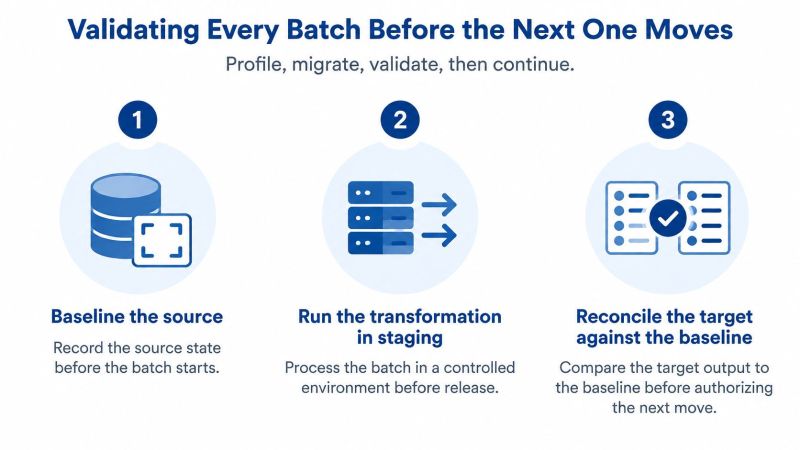
The International Journal of Open Information Technologies migration guidance supports a profile, migrate, validate control loop. Baseline the source, execute transformations in a controlled staging environment, then reconcile the target before authorizing the next batch.
Reconciliation checks by layer
| Check | Layer | What it catches |
|---|---|---|
| Row counts and checksums | Technical | Dropped or duplicated records and unintended content differences |
| Schema drift detection | Technical | Columns changed, missing or retyped after load |
| Constraint and referential checks | Technical | Broken parent-child links between tables |
| Financial control totals | Business | Balance or revenue errors hidden by equal row counts |
| Key uniqueness and mandatory fields | Business | Duplicate customers or empty required fields |
| Application workflow tests | Business | Processes that fail when users work with the migrated data |
Define the expected result for intentional transformations. If deduplication reduces customer counts, reconcile source records to retained customers through an explicit crosswalk rather than demanding identical totals. For checksums, normalize representations where approved transformations change formatting without changing meaning.
Keep baseline snapshots, mapping versions, load identifiers and reconciliation outputs together. Intermediate databases can preserve inspection points, while statistical summaries of numeric and categorical fields help reviewers identify unexpected shifts. Use stratified sampling across regions, statuses, record ages and exception types when full field comparison is impractical; sampling doesn't replace mandatory financial or integrity controls.
Make the batch release sequence visible to operators.
Select automation by its controls
For a complementary testing perspective, use migration validation advice from PlatformDTC when preparing tool evaluation questions. Define the required SAP data validation evidence before choosing how to automate it.
Our proprietary Pulse migration accelerator automates data mapping and validation and allows high-speed ingestion without compromising integrity. That capability supports repeatable execution, but business owners still need to approve the rules and acceptance evidence.
Judge any accelerator through a demonstration using representative data. Require it to show:
- Controlled execution. Profiling, mapping and reconciliation operate within a traceable run.
- Audit evidence. Each batch retains its inputs, rule versions, exceptions and approval status.
- Incremental replay. Operators can rerun a failed batch without duplicating successful work.
- SAP dependency handling. Customer and material keys are available before dependent transactional history loads.
Don't discover a shared transformation defect after downstream batches have already used its output. Retain rollback or replay capability for every failed batch, and stop dependent releases until its acceptance evidence passes.
Cutover, Rollback and Running the Business Through Migration
Zero downtime shouldn't be treated as the default outcome. In a 2025 survey of more than 300 IT leaders described in CTERA's State of Data and Cloud Strategy survey material, only 6% reported zero downtime during their most challenging database migration, and nearly half experienced at least five hours. The operational question is what the organization can safely do while systems are unavailable or inconsistent.
Write a runbook people can execute
Rehearse the business process on a copy. Test an order through fulfillment, an invoice through posting and a stock movement through reporting. Record elapsed time, failed dependencies and operator decisions, not just load completion.
Freeze source changes at an agreed time. Identify who can authorize an emergency write and how it enters the migration record. Disable or control unattended interfaces that could bypass the freeze.
Load the final delta. Capture the final source position and prove that outstanding changes have reached the target. Keep the extraction and load evidence available to the decision team.
Run release checks. Execute the approved technical and business reconciliations, then test access, interfaces and critical workflows. Record results against the release criteria rather than discussing whether the system looks healthy.
Hold a go or no-go decision. The designated release authority reviews evidence and remaining time with business representatives. The runbook must name who can order rollback without waiting for an unavailable executive.
Maintain a defined rollback window. Keep the source recoverable until agreed conditions are satisfied. Document how transactions created after cutover will be captured, reconciled and replayed if operations return to the source.
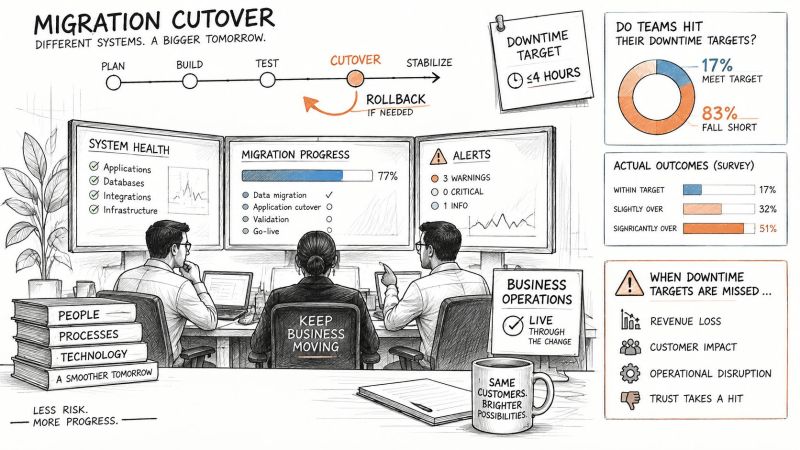
The operating team needs a shared view of decisions, elapsed time and unresolved issues during cutover.
Protect operating capacity
Set downtime tolerance by function. Warehouse dispatch, payment processing and historical reporting need different arrangements; a program-wide availability target won't tell operators when to switch procedures.
Define rollback triggers in operational terms: an unreconciled critical balance, failure of a mandatory process or insufficient remaining recovery time. Include the latest safe decision point, because a technically possible rollback may no longer fit the business window.
Parallel operation also needs explicit rules. Name the authoritative system for each process, explain how teams record work during outages and prevent users from entering the same transaction independently in both systems.
Reserve capacity for business validators, service-desk staff, trainers and integration owners. Don't schedule them as fully available for migration while leaving their normal workload unchanged. Rehearse the business process, not only the data load.
Success Metrics and Governance Gates That Prove Readiness
The widely cited migration risk benchmark needs careful handling. Quinnox's enterprise migration planning guide cites Gartner's historical estimate that more than 83% of migration initiatives fail outright or exceed planned timelines and budgets. That broad measure combines different outcomes; it isn't a precise universal failure rate.
The useful lesson is that transfer mechanics don't define program success. Incomplete requirements, underestimated transformation work, weak ownership and operational disruption can invalidate an otherwise completed load.
Define acceptance by business domain
Use an enterprise data governance framework to connect acceptance decisions to accountable owners. The release rules should be explicit:
- No unexplained record loss. Every exclusion, consolidation and rejected record has an approved disposition and a traceable relationship to the source.
- Reconciled domain control totals. Finance, inventory and other critical domains have signed reconciliation evidence, with approved treatment of rounding or intentional adjustments.
- Domain-specific exception thresholds. A missing optional description is not equivalent to a missing payment instruction. Set tolerance by consequence, not by a blended program average.
- Defect aging limits. Each severity class has a resolution deadline and an escalation owner; an old defect doesn't become acceptable merely because it remains open.
- Dataset acceptance. Business owners sign against defined workflows and data outcomes, rather than approving a technical completion report they can't interpret.
These gates distinguish operational readiness from engineering completion. Any waiver should state exactly what users can't do, who accepts that limitation and what restores normal operation.
Track readiness during execution
Monitor validated batches against plan, not merely bytes loaded. Track open exceptions by age and business severity so the steering committee can distinguish a shrinking backlog from one filled with newly discovered defects.
Measure rework rate as repeated work against completed work, using a consistent definition. Rising rework warrants a pause to inspect mapping stability, source changes or test quality rather than an automatic request for more loading capacity.
Compare downtime with each function's accepted tolerance, and track actual dual-running expenditure against the approved cost model. Before closing the program, transfer unresolved support responsibilities, monitoring procedures and recovery instructions to named operational owners.
Completion is a technical event. Acceptance is a business decision.
Agree these measures with business owners before the first batch moves. Otherwise, the delivery team may optimize for load completion while the organization waits for usable, supportable data.
We offer SAP Data Migration Services designed to make migration cost-optimized from the start, supported by business and data specialists. Visit Kagool and share your SAP migration requirements, capability gaps and continuity constraints so we can help shape the assessment and delivery approach.

