

A cutover can look successful while the business is already failing underneath it. A manufacturer goes live on S/4HANA, users log in, documents post, and the project team closes its checklist. Then the first vendor payment run rejects transactions because duplicate supplier records were merged incorrectly during the load. The technical migration completed, but the business data did not survive the transition with its meaning intact.
That is the problem SAP data validation must solve. It proves that data is complete, accurate, consistent, traceable, and fit for the business process that depends on it. The discipline applies to a one-off migration into S/4HANA or BW/4HANA, integrations using RFCs and IDocs, and ongoing synchronization with Azure, Databricks, Snowflake, or another analytical platform. It also needs to expose failures early enough for a team to fix them before they become reconciliation work, audit findings, broken dunning, or prolonged hypercare.
Table of Contents
- What SAP Data Validation Really Means and Why It Matters
- Scoping, Profiling, and Mapping Your SAP Data
- Core Validation Checks You Can Run in Every Cycle
- Migration Validation Versus Ongoing Sync Validation
- Tooling, Integration Patterns, and the Accelerator Stack
- KPIs, Observability, and a Pulse Validation Walkthrough
- Common Pitfalls and a Practical Adoption Checklist
What SAP Data Validation Really Means and Why It Matters
SAP data validation is often reduced to a simple question: did the target system receive the same number of records as the source? That check matters, but it proves only that a quantity moved. It doesn't prove that the right supplier was linked to the right company code, that an open item retained its payment terms, or that a material remained connected to its bill of materials and downstream planning process.
Validation sits between data quality management, migration testing, and operational control. Cleansing changes bad or inconsistent data. Transformation testing checks whether technical rules behave as designed. Validation confirms that the resulting data is trustworthy in the target context and that the surrounding process can use it correctly.
Three operating contexts
The first context is migration validation. During an ECC to S/4HANA conversion, a selective transition, or a move into BW/4HANA, the team must compare source and target data across repeated load cycles. SAP's Business ByDesign migration guidance instructs users to compare migrated record totals with target totals, then perform spot checks on individual records before reusing value-conversion files in production. That workflow makes validation a control throughout migration, not a sign-off ceremony at the end.
The second context is integration validation. RFCs, IDocs, BAPIs, OData services, and event-driven interfaces can deliver technically valid messages that produce incomplete or semantically wrong business records. A successful acknowledgement doesn't necessarily mean the receiving process has the expected customer, vendor, material, or financial context.
The third context is steady-state synchronization. Once SAP feeds Azure Data Lake, Databricks, Snowflake, or a reporting platform, validation must monitor deltas, replication drift, late-arriving records, schema changes, and broken relationships. A migration team can perform a full reconciliation during a cutover. An operations team needs smaller, repeatable checks that run with the data flow.
Practical rule: Validate the data where a business decision uses it, not only where a load process says it arrived.
Weak validation usually fails because teams treat it as a project activity. They run a few extracts, ask business users to inspect samples, and archive spreadsheets after go-live. That approach leaves no durable control for a new plant, a changed mapping, a failed IDoc batch, or a revised analytical model. A rules-driven approach turns the same business expectations into repeatable assertions, exception queues, and evidence that technical and functional owners can review.
Scoping, Profiling, and Mapping Your SAP Data
Reliable validation starts before the first migration load. The team needs a defined population, a known baseline, and an agreed interpretation of every field that matters. Without those foundations, a failed check may indicate bad data, an incorrect transformation, an incomplete extract, or a disagreement between business owners.
Start with process scope
Organize the scope around business processes rather than isolated SAP tables. For FI-AP, identify suppliers, company codes, open items, payment terms, tax information, and relevant accounting documents. For FI-AR, include customers, receivables, dunning attributes, and clearing relationships. MM-PUR and SD-SLS need their master data, document flows, organizational assignments, and status fields. CO-PA requires particular care with derivations, characteristics, and value fields.
Document the source systems that contribute to each object. The source may be ECC, a non-SAP application, a legacy warehouse, a merger platform, or an externally maintained reference file. Then define the target environment, including S/4HANA, BW/4HANA, Azure storage, Databricks, Snowflake, and reporting or planning consumers.
A practical SAP data migration strategy should identify what will be migrated, what will be transformed, what will be archived, and what will remain outside the target. That decision determines the validation population. A count cannot be reconciled if nobody has agreed whether historical documents, inactive materials, or closed items belong in scope.
Profile the source before setting thresholds
Profiling creates the baseline against which every later cycle is measured. Use ABAP reports, extract-layer queries, ADSO outputs, or profiling logic in Snowflake and Databricks to examine:
- Population shape: Row counts by company code, plant, sales organization, document type, and fiscal period.
- Completeness: Null rates for mandatory fields, blank clusters, and unexpected default values.
- Uniqueness: Distinct counts for keys, supplier identifiers, customer numbers, and material numbers.
- Validity: Date ranges, currency codes, units of measure, tax codes, and status values.
- Distribution: Amount and quantity patterns, unusually dominant values, and outliers that need business review.
A profile is not a quality verdict by itself. A high null rate may be acceptable for an optional field and unacceptable for a posting-relevant field. The functional owner must define the meaning of an exception before the technical team turns it into a rule.
Make mapping a living control
The mapping register should contain the source field, transformation rule, target field, business owner, technical owner, permitted values, and tolerance. Add the source object and target object, dependency information, and the rule that will validate the result. When a field changes, update the mapping and the assertion together.
SAP's S/4HANA data-quality documentation describes a governed pattern in which validation rules are approved in advance, executed in evaluation runs, and surfaced through dashboards with quality trends and KPIs. It also describes thresholds and weighted impacts that support scoring, drill-down, and correction. Use that model to keep mappings operational rather than treating them as static project documents.
The baseline should be approved by both data and functional owners. It then becomes the reference for every mock load, dress rehearsal, cutover decision, and post-go-live sync check.
Core Validation Checks You Can Run in Every Cycle
A migration cycle can pass its record-count check and still deliver incorrect business data. A vendor total may match while company-code assignments, bank details, payment terms, or duplicate keys are wrong. Validation therefore needs three layers: deterministic controls for clear pass or fail results, statistical controls for drift, and targeted human review for exceptions that require business judgment.
Start at object level, then drill into fields, relationships, and business conditions. Run the same control set during mock loads, dress rehearsals, cutover preparation, and post-go-live sync checks. Storing results by cycle makes a rule breach traceable instead of leaving the team with an isolated test report.
The control set
| Check | What It Catches | When to Use |
|---|---|---|
| Record and object counts | Missing loads, duplicate loads, incomplete extracts, and unexpected scope changes | Every migration and sync cycle |
| Hash totals and financial footing | Changed key fields, amount drift, quantity discrepancies, and aggregation errors | Financial, inventory, and high-volume objects |
| Referential integrity | Orphaned customers, vendors, materials, cost centers, profit centers, GL relationships, or document links | After each load and after structural changes |
| Schema and field validation | Wrong data types, truncated values, invalid dates, blank mandatory fields, and mapping defects | Before load and immediately after load |
| Business rule reconciliation | Invalid tax codes, inconsistent payment terms, unbalanced document types, or unexpected open-item status | During dress rehearsals and business acceptance |
| Failure-pattern detection | Repeated errors, recurring mapping defects, and failed partitions | Every automated run |
| Exception sampling | High-value, high-risk, or unusual records that need human confirmation | After automated checks, not instead of them |
SAP community guidance on automated validation for S/4HANA migrations highlights source-to-target counts, financial reconciliation, repeated-failure detection, pattern-based anomaly detection, column-level checks, and subset spot checks. The practical lesson is to combine controls. A single assertion cannot establish confidence across a complex SAP object model.
Automate the broad checks, review the meaningful exceptions
SQL assertions and Python or PySpark tests handle counts, sums, null detection, key uniqueness, date validation, and relationship checks well. Run them against every cycle and store each result with the load identifier, source extract, target version, rule version, timestamp, and owner. Teams assessing enterprise data quality tools for automated checks should confirm that the platform supports this evidence trail, rule versioning, exception ownership, and repeatable execution.
Accelerators such as Pulse, Velocity, and SparQ can change the operating model by making these rules reusable across migration and synchronization runs. The value comes from repeatable controls and visible exceptions, not from replacing functional ownership. Rules still need an agreed scope, tolerance, and escalation path.
Use hash totals carefully. A checksum on selected key fields can expose changed values that a row count misses. Sums of financial amounts and quantities provide a business-facing footing, but both sides must use the same scope, currency logic, sign convention, and rounding treatment. Otherwise, the check reports a transformation design difference as a data defect.
Manual review remains appropriate for selected high-value suppliers, unusual materials, large open items, tax-sensitive documents, and records affected by a changed mapping. Keep the sample risk-based and document the reviewer, decision, and reason for escalation. Sampling-based UAT can miss duplicates, missing mandatory fields, and transformation errors that appear only at production volume, as described in a recent analysis of SAP UAT validation gaps.
A passing count is evidence of volume, not evidence of correctness.
Set thresholds before execution. A deterministic rule may permit no orphaned references, while a distribution check may allow a business-approved variance range. When a threshold breaches, the workflow should identify the affected object, records, transformation rule, and responsible owner. That connects detection to correction and makes validation a rules-driven discipline across the full migration and sync lifecycle.
Migration Validation Versus Ongoing Sync Validation
Migration and synchronization share a control vocabulary, but they don't share the same operating rhythm. Migration validation proves that a defined population moved correctly during controlled cycles. Ongoing sync validation proves that changes continue to arrive, remain consistent, and preserve relationships after the system becomes operational.
During migration, run full-volume checks wherever the source and target populations are comparable. Reconcile load completeness, transformation fidelity, financial footing, and dependencies. Preserve the evidence for each rehearsal and define the point at which the team can back out or reload. A legacy extract that was incomplete before transformation is a migration issue. It shouldn't be mistaken for a target-load defect.
After go-live, the focus moves to deltas. Monitor change-data-capture feeds, IDoc acknowledgements, replication batches, late records, duplicate events, and schema drift. A feed may be available while a subset of records is delayed or rejected. The operating team needs alerting, retry handling, and a clear owner for each failure class.
| Dimension | Migration Validation | Ongoing Sync Validation |
|---|---|---|
| Population | Full in-scope population and defined historical scope | New and changed records since the previous successful run |
| Main question | Did the target reproduce the approved source and transformation? | Is the flow continuing without drift or relationship breakage? |
| Frequency | Each mock load, rehearsal, and cutover cycle | Scheduled or event-driven, based on business criticality |
| Typical controls | Load balance, source dump integrity, transformation checks, backout evidence | CDC completeness, replication lag, IDoc status, retry and drift detection |
| Failure response | Correct mapping, reload, or revise cutover decision | Retry, quarantine, repair, and escalate without stopping unrelated flows |
| Controls retained | Counts, keys, relationships, business rules, and financial reconciliation | Counts, keys, relationships, business rules, and financial reconciliation, tuned to deltas |
Some migration controls should retire after cutover. A legacy dump integrity check has no role once that source is decommissioned. Other controls need hardening, not removal. Referential integrity, business-rule reconciliation, and schema validation should continue wherever downstream processes depend on the data.
The handover should include rule ownership, threshold rationale, alert routing, run history, and procedures for changing a rule. If the project team leaves only a final validation workbook, the operational team has inherited a manual exercise rather than a control.
Tooling, Integration Patterns, and the Accelerator Stack
The validation environment should separate extraction from assessment. Pulling data directly from production for every comparison creates pressure on the SAP system and makes repeated testing harder to govern. A landing layer gives the team immutable extracts, repeatable transformations, and a place to run SQL or PySpark assertions without mixing operational transactions with analytical checks.
Native RFC and IDoc extraction remains useful for established SAP interfaces. BAPIs and OData services can support controlled object access, while CDS view extracts provide a structured route into cloud and analytical platforms. The right pattern depends on the object, release, volume, security model, and the interface contract. Don't force a single extraction method across master data, transactional data, and operational deltas.
A practical validation architecture
- Extract: Capture SAP objects and interface outcomes with an extract identifier and source timestamp.
- Land: Store raw and transformed data in Azure Data Lake or Databricks Delta, preserving lineage between versions.
- Validate: Run SQL and PySpark assertions for counts, keys, fields, relationships, financial totals, and business rules.
- Report: Publish exceptions, scores, trends, and owner actions in a format that functional and technical teams can use.
The accelerator stack described in Kagool's Pulse SAP data migration overview fits into this pattern as an operating layer. Velocity handles high-volume SAP-to-cloud extraction and loading. Pulse orchestrates rules-driven validation and threshold scoring. SparQ presents reconciliation and governance information for technical and business owners. In combination, the flow is straightforward: Velocity feeds the landing layer, Pulse runs the checks, and SparQ makes the result actionable.

The value isn't a product label. It's the removal of manual handoffs. A repeatable ingestion path avoids rebuilding extraction logic for each rehearsal. A central rules catalogue avoids maintaining disconnected SQL scripts and spreadsheets. A reconciliation view gives the cutover team one place to see failed rules, affected objects, owners, and remediation status.
The trade-off is governance effort. Accelerators still need carefully designed mappings, approved thresholds, security controls, and functional ownership. Automation can execute a bad rule perfectly. Start with a small set of high-risk objects, prove the evidence trail, then extend the catalogue across the entire environment.
KPIs, Observability, and a Pulse Validation Walkthrough
A validation dashboard should answer whether the migration is safe to proceed, not merely whether a job completed. The core indicators are record-count variance, hash-total drift, referential integrity ratio, business-rule pass rate, exception age, and time to detect an injected defect. Track them by object, business process, cycle, and owner so that an overall score doesn't conceal a serious failure in one area.
SAP's data-quality evaluation model for S/4HANA describes approved rules, evaluation runs, dashboards, thresholds, weighted impacts, and drill-down analysis. That combination supports an important operating principle: a quality score is useful only when the team can move from the score to the failed records and then to the correction owner.
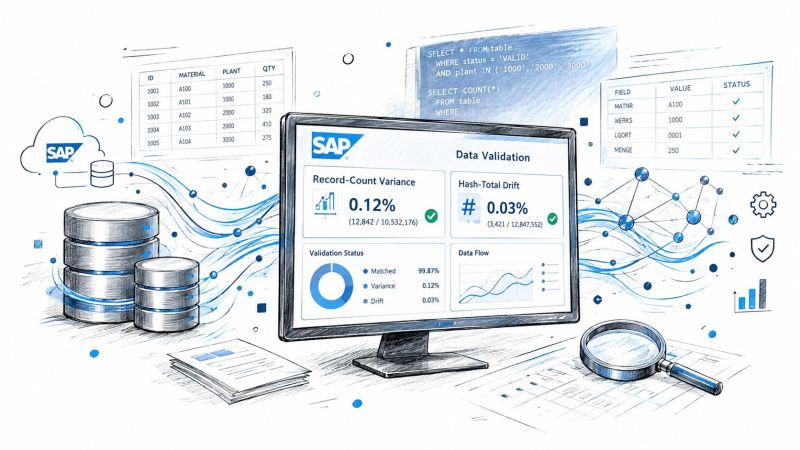
Consider a representative S/4HANA dress rehearsal. The team loads vendor, material, and customer master data into the target, then runs rules for completeness, uniqueness, organizational assignment, relationship integrity, and mapping consistency. Pulse groups failures by object and severity rather than presenting one undifferentiated error list. The lead architect can see whether the problem comes from the source, the transformation, the load, or a downstream relationship.
The key decision is not “does the dashboard look green?” It is whether every critical rule has passed or has an approved exception, whether unresolved issues have named owners, and whether the remaining risk is acceptable for the business process. A material mapping defect may be more serious than a larger number of harmless formatting exceptions if it changes how planning or purchasing identifies the material.
The team should also test observability itself. Inject a known defect into a controlled cycle and confirm that the relevant rule detects it, that the alert reaches the cutover group, and that the record can be traced back to its source and transformation. A control that can't demonstrate detection and traceability isn't ready to support a go-live decision.
Use trend lines to distinguish an isolated defect from recurring drift. Monitor exception ageing so that old failures don't disappear beneath newer runs. Keep the run evidence, rule version, threshold, approval, and remediation outcome together. That record gives the project a defensible basis for go or no-go and gives operations a starting point for post-go-live monitoring.
Common Pitfalls and a Practical Adoption Checklist
The most common mistake is treating UAT as the validation gate. UAT confirms that users can execute selected scenarios. It doesn't provide full-volume evidence that every relevant record, relationship, transformation, and downstream dependency is correct.
Other failures are predictable:
- Counting without reconciling: Matching row totals can hide duplicate keys, missing mandatory fields, and changed business values.
- Validating only after cutover: Late discovery leaves little time for correction, reload, or informed business decisions.
- Ignoring configuration and transactions: Master data may look clean while document types, tax codes, payment terms, or organizational assignments break the process.
- Using isolated spreadsheets: A workbook rarely preserves rule versions, execution history, ownership, threshold decisions, and complete exception lineage.
- Automating without governance: Unapproved rules and unclear thresholds create fast, repeatable confusion.

A 90-day adoption sequence
Weeks one and two, establish ownership. Inventory SAP and non-SAP sources, identify critical business objects, document integration paths, and assign data owners. Agree which processes define criticality and which records require business review.
Weeks three through six, profile and baseline. Capture completeness, uniqueness, validity, distributions, relationships, and reconciliation results. Record the current error patterns before cleansing or transformation changes alter the population.
Weeks seven through ten, codify controls. Convert approved expectations into reusable rules. Connect automated execution to the landing layer, define thresholds, route exceptions, and publish a dashboard that both functional and technical owners can interpret.
Weeks eleven and twelve, prove repeatability. Run a parallel validation cycle against a migration load, compare results with the baseline, tune thresholds with business approval, and test defect detection and escalation.
A cycle is green only when critical deterministic checks pass, threshold breaches have documented disposition, financial and relationship reconciliations are accepted, high-risk exceptions have named owners, and the evidence is reproducible by someone who didn't run the original test. That is a stronger gate than a successful load or a small UAT sample.
Kagool combines SAP migration planning, extraction, transformation, validation, reconciliation, and post-go-live support for teams operating across SAP, Azure, and Databricks. Visit Kagool to discuss a rules-driven validation approach for your next migration or synchronization program.

