

Your SAP finance team reports one revenue figure, Power BI shows another, and a Databricks notebook produces a third. The numbers may all be technically correct within their own systems, yet the executive meeting still ends with the same question: which definition should the business trust?
That problem becomes harder when AI projects arrive. A copilot can retrieve a customer record from SAP, a document from a content repository, and a metric from Microsoft Fabric, but those assets may use different identifiers, dates, hierarchies, and meanings. The result is an AI pilot that can access data without reliably understanding the business.

Unified data modeling addresses this issue at the business meaning layer. It isn't another extraction project, a larger lakehouse, or a mandate to place every record in one table. It creates shared definitions, relationships, rules, metadata, and access policies so SAP, Microsoft Fabric, Power BI, Databricks, analytics workloads, and AI applications can work from compatible business concepts.
This guide is for CIOs, IT directors, data leaders, architects, and operations teams responsible for making enterprise data usable beyond its original system. It moves from the basic idea to architectural layers, the choice between a canonical model and federated semantics, semantic-layer governance, Microsoft and SAP patterns, and the operating discipline required after go-live.
If your organization is considering a unified data platform, the important decision isn't whether every source should look identical. The important decision is how your organization will define business meaning once, publish it responsibly, and keep it reliable as systems and AI use cases change.
Table of Contents
- Introduction Why Unified Data Still Feels Fragmented
- What Unified Data Modeling Really Means
- Core Layers That Make a Model Truly Unified
- Choosing Between a Single Model and Federated Semantics
- How Governance and Security Work at the Semantic Layer
- Enterprise Patterns for Microsoft and SAP Analytics
- Making Your Unified Model AI Ready and Sustainable
Introduction Why Unified Data Still Feels Fragmented
A typical enterprise doesn't have one data problem. It has a collection of systems that each solve a legitimate problem.
SAP ECC or S/4HANA manages transactions, finance, procurement, materials, and operational processes. Microsoft Fabric brings together engineering, warehousing, analytics, and governance capabilities. Power BI presents metrics to business users, while Databricks supports data engineering, advanced analytics, and AI workloads. Each platform can be well implemented and still contribute to fragmentation if teams model the same business concept differently.
Consider “customer.” SAP may identify a business partner through one set of keys, a CRM application may use another, and a service platform may represent the same organization through account and contact structures. A Power BI report might classify revenue by billing customer, while an operations report groups it by sold-to party. Neither definition is automatically wrong. The failure occurs when the organization treats them as interchangeable without documenting the difference.
Architectural principle: A unified model should make business meaning reusable, not merely make data physically adjacent.
Why integration alone doesn't solve the problem
Integration moves and transforms data. It can connect SAP tables to Azure storage, replicate records into a lakehouse, and expose curated datasets to reporting tools. But integration doesn't decide whether “net sales,” “active employee,” “on-time delivery,” or “inventory availability” means the same thing in every consuming product.
Unified data modeling adds that interpretive layer. It identifies shared entities, attributes, relationships, measures, ownership, lineage, and permitted uses. The result is a business-facing contract that different tools can consume without forcing every platform to adopt an identical physical implementation.
The need has a long history. Unified approaches grew from database management work in the 1960s, while the consolidation of modeling practices accelerated in the mid-1990s with UML, according to a historical survey of data modeling. The current challenge is newer in shape, not in principle. Organizations still need a common way to describe increasingly complex systems.
What leaders should be able to decide
By the end of this guide, you should be able to distinguish:
- Integration from modeling: moving records versus aligning meaning.
- A canonical model from federated semantics: one shared structure versus coordinated domain models.
- Storage security from semantic security: protecting files and tables versus enforcing business-aware access.
- A delivery project from an operating model: launching a design versus maintaining definitions, metadata, quality, and ownership.
That distinction matters because AI readiness depends on more than connectivity. AI applications need context, active metadata, governed pipelines, and data that can support both analytical interpretation and live operational use, as discussed in the enterprise architecture guidance for unified data.
What Unified Data Modeling Really Means
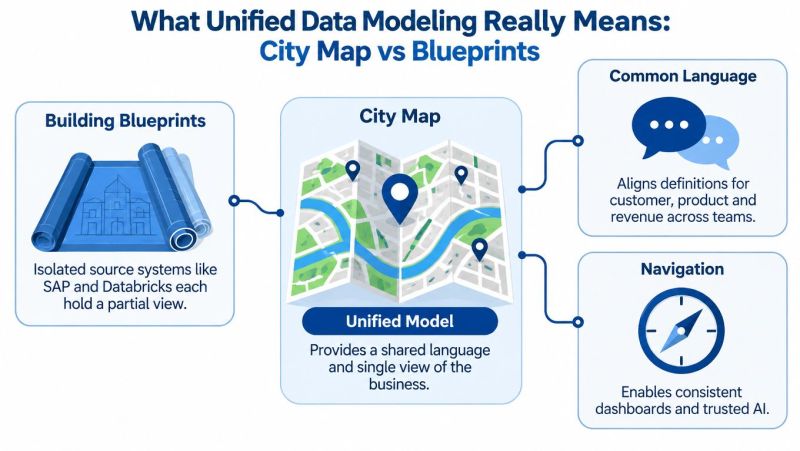
Think about the difference between building blueprints and a city map.
A blueprint describes one building in detail. It may show rooms, entrances, pipes, and electrical systems, but it doesn't tell you how that building relates to the hospital, warehouse, road, or district next door. SAP, Fabric, Databricks, and other applications often behave like collections of blueprints. Each system documents its own structures and processes.
A city map answers a different question. It shows the important landmarks, roads, boundaries, and connections in a shared frame of reference. It doesn't erase the internal design of every building. It gives residents, planners, and emergency services a common language for navigating the whole city.
Start with business entities
Unified data modeling begins by naming the things the organization needs to understand consistently. These may include:
- Customer: The party associated with a sale, service relationship, or account.
- Product: The item, service, material, or SKU represented across commercial and operational systems.
- Order: The commercial commitment, including its status, dates, and line items.
- Revenue: A governed measure with an explicit scope, calculation, currency treatment, and time basis.
The model then describes how those entities relate. A customer may have orders. An order may contain products. A product may belong to a hierarchy. Revenue may be derived from transactions under defined accounting or commercial rules.
Separate three ideas that are often confused
Data integration connects sources and moves data between them. It answers, “How do we bring this information together?”
Data unification reconciles records and creates a more complete profile or view. It answers, “Which records refer to the same business object?”
Unified modeling defines the shared structure and meaning that consumers use. It answers, “How should every team describe, relate, calculate, govern, and access this object?”
Those activities support one another, but they aren't substitutes. A platform can ingest data successfully while leaving departments with conflicting definitions. It can also create a consolidated profile without documenting the rules that produced it.
Unified doesn't mean one physical table
A harmonized model is the final structured layer that presents agreed business entities and relationships to analytics, AI, and operational consumers. The underlying data may remain distributed across lakehouse tables, domain products, indexes, document stores, or platform-specific structures. What must be consistent is the published meaning and the rules for using it.
That distinction gives architecture teams room to preserve source fidelity while creating a dependable business view. The “single view” is often logical and semantic, not a single physical object.
Core Layers That Make a Model Truly Unified
A unified model works as a stack. Each layer handles a different responsibility, and skipping a layer usually pushes complexity into the next one.

The five-layer stack
1. Ingestion connects source systems and captures data in a form that preserves useful source context. In an SAP and Microsoft environment, this may include transactional data from ECC or S/4HANA, data from Fabric workloads, and analytical assets managed in Databricks.
2. Harmonization cleans, maps, reconciles, and aligns the incoming information. Teams address different customer identifiers, product codes, currencies, calendars, units of measure, and status values. The output can support a more complete profile assembled from disparate sources.
3. Modeling defines the business entities, attributes, relationships, metrics, and rules that consumers should understand. This is the semantic core. A model isn't merely a list of columns. It explains what a field means, how it relates to other fields, and which calculation or interpretation is approved.
4. Storage persists the curated structures in technology suited to the workload. A lakehouse, warehouse, serving database, or other store can provide performance and scale, but storage alone doesn't establish shared meaning.
5. Access exposes governed data to reporting, applications, analysts, AI tools, and data agents. Access should preserve the semantic rules rather than forcing every consumer to rebuild them independently.
Practical rule: Treat the harmonized model as the governed business-facing layer, then let multiple tools consume it.
The Microsoft Fabric and OneLake architecture can support this kind of layered design, but the platform doesn't remove the need for decisions about entities, definitions, ownership, and access boundaries.
Why the layers matter
Without harmonization, teams may join records that look similar but represent different things. Without a semantic model, reports can apply local interpretations to shared data. Without governed access, users may see more information than their role permits. Without lineage, a metric owner can't explain where a value originated or which downstream products depend on it.
The architecture source describing modern enterprise unification places ingestion, harmonization, modeling, storage, and access within the broader unification process, with the harmonized data model as the final structured layer. That positioning is important. The semantic layer isn't decoration placed on top of a finished platform. It is the point where technical assets become reusable business information.
The same principle applies outside analytics. An HR team evaluating an HRMS may need a separate guide to HRMS ROI and compliance to assess the application decision, but the enterprise data architect still needs to model employee, organizational, payroll, and compliance concepts consistently with the wider information estate.
The stack describes structure. Governance determines who can change it, who can use it, and how the organization knows whether it remains trustworthy.
Choosing Between a Single Model and Federated Semantics
The most important modeling decision is often framed too directly: should the organization build one canonical model?
A single canonical model can create strong consistency when the business has shared definitions, manageable domain boundaries, and a clear authority for approving changes. A gold or star-schema layer aligned to business domains can give reporting, copilots, and data agents a stable foundation. Microsoft's reference architecture recommends certifying semantic models on top of gold data products so business definitions, relationships, and rules can be reused across consumers.
The difficulty appears when the organization combines structured ERP data with documents, emails, images, and vectorized content. These assets don't all behave like relational records. Forcing them into one universal schema can create an abstraction that is difficult to govern and awkward for both analysts and AI systems.
A federated approach keeps domain-specific models while coordinating them through shared identifiers, common definitions, active metadata, lineage, and governance rules. It doesn't mean every domain can invent its own vocabulary. It means domains retain appropriate structures while publishing interoperable semantics.
Decision matrix
| Criterion | Single Canonical Model | Federated Semantics |
|---|---|---|
| Business definitions | Centralized definitions are easier to present and audit | Shared glossary and mappings coordinate definitions across domains |
| Domain diversity | Works best where entities and rules are broadly consistent | Handles different operating models, regulatory contexts, and specialist structures |
| Structured ERP reporting | Efficient for common dimensions, facts, and governed metrics | Suitable when finance, supply chain, HR, and commercial domains need autonomy |
| Unstructured content | Can become too rigid if documents and vectorized content are forced into relational patterns | Keeps content-native representations while linking them through metadata and business entities |
| Change management | A change can have broad impact and require centralized approval | Local changes can move faster, but cross-domain contracts need active oversight |
| AI use cases | Provides a clear shared context for common questions | Supports different retrieval, feature, and domain patterns while preserving governance |
| Main risk | Central bottlenecks and overgeneralization | Semantic drift if glossary, lineage, and ownership aren't actively managed |
The contrarian answer is that “one model” is often unrealistic in large enterprises. A governed federation may outperform a single canonical structure when business units, platforms, and data types differ materially. The model remains unified at the semantic and governance level, while physical representations stay fit for purpose.
Use a canonical layer for shared concepts. Use federated semantics where domain context matters. Then connect both through controlled metadata operations rather than informal agreements.
How Governance and Security Work at the Semantic Layer
A secure storage platform doesn't automatically produce secure business data. Permissions applied to files, tables, or lakehouse objects can protect the underlying asset while leaving the business access rule incomplete.
Suppose a sales manager should see accounts in one region, while a finance analyst can see a broader reporting scope. The organization needs more than a storage permission. It needs a model-aware policy that understands the relevant business entity, relationship, and role.

Build controls into the model boundary
A semantic governance stack commonly includes:
- Row-level security: Filters records according to region, business unit, role, or another approved context.
- Object-level security: Hides sensitive tables, fields, or measures from roles that shouldn't use them.
- Sensitivity labels: Classifies information and supports protection policies for confidential or regulated content.
- Lineage and catalog integration: Shows where data originated, how it changed, who owns it, and which reports or AI assets depend on it.
Microsoft Fabric guidance also warns that users with direct access to underlying Lakehouse data may bypass row-level security. That means the architecture must align permissions with the semantic boundary. If users can reach the source through an unrestricted path, a carefully designed report model may not provide the intended protection.
Certify the reusable business layer
A certified semantic model should expose approved relationships, measures, hierarchies, and business rules. Power BI reports can reuse those definitions rather than embedding separate calculations. Copilot-style experiences and data agents can also use the same governed context, subject to their own access controls and appropriate grounding.
This model-centered approach reduces semantic drift because the organization controls meaning where consumers encounter it. It also makes review more practical. Data owners can inspect the model, policy owners can validate access behavior, and platform teams can trace dependencies through the catalog.
The Databricks Unity Catalog governance guidance is useful when teams need to connect catalog, lineage, permissions, and data-product practices in a Databricks environment. The technology choice matters, but the operating rule matters more: don't publish a metric without publishing its definition, owner, lineage, and access policy.
Enterprise Patterns for Microsoft and SAP Analytics
A practical SAP and Microsoft architecture usually begins with source fidelity. SAP ECC or S/4HANA remains the system of record for relevant transactions, while an ingestion pattern moves selected data into the enterprise analytics environment. The goal isn't to flatten every SAP structure immediately. The goal is to preserve traceability while creating curated domain products that business users can understand.
A common pattern places finance, inventory, procurement, sales, and workforce information into domain-aligned gold structures. Each domain product contains conformed entities and carefully documented measures. Finance may publish a governed revenue concept, while inventory publishes stock, movement, and availability concepts. Shared dimensions, such as organization, product, supplier, customer, and calendar, connect the domains where the business meaning overlaps.
A reusable consumption path
The path can be described:
- Extract from SAP: Capture the required ECC or S/4HANA data with source identifiers and operational context intact.
- Harmonize across platforms: Map SAP codes and structures to enterprise definitions used in Fabric, Power BI, and Databricks.
- Publish gold data products: Organize curated data by business domain, using star-schema patterns where they help reporting and analysis.
- Certify semantic models: Place approved metrics, relationships, and business rules above the gold layer.
- Reuse across consumers: Let dashboards, notebooks, applications, copilots, and data agents use the same governed definitions.
This pattern prevents a Power BI developer from creating one interpretation of revenue while a data scientist creates another in Databricks. It also gives operations teams a clearer path from an executive metric back to the SAP transaction or transformation rule that produced it.
Where accelerators fit
Delivery tools should support the architecture rather than replace it. An SAP-to-Azure ingestion accelerator can help teams establish repeatable extraction and transformation patterns. A governed transformation environment can help data engineers apply mappings, quality rules, and lineage consistently. A reporting and governance suite can help publish reusable semantic assets for finance, inventory, and HR.
Kagool offers services and accelerators across SAP, Microsoft, and Databricks ecosystems, including Velocity for SAP-to-Azure no-code data ingestion and the SparQ suite for reporting, data governance, transformation, insights, and security. These capabilities are relevant when an organization needs to connect source integration with governed modeling, but the business still must approve definitions, ownership, and change control.
The strongest pattern is therefore not “SAP into Fabric” or “SAP into Databricks.” It is source systems into governed domain products, governed domain products into certified semantics, and certified semantics into every approved consumer.
Making Your Unified Model AI Ready and Sustainable
AI-ready data requires more than a clean schema. Gartner's guidance says leaders must first define what counts as AI-ready data, with readiness depending on active metadata, governance, and pipelines that support both training and live AI feeds. IBM's coverage adds a major practical obstacle: up to 90% of enterprise data can be trapped in unstructured silos, which makes a completely unified model difficult to build and maintain. See the source discussing AI-ready data and unstructured silos.
That reality changes the architecture conversation. Structured SAP and BI data can use relational and dimensional models, while documents, emails, images, and vectorized content may need different representations. The enterprise can still unify the meaning through entities, metadata, lineage, retrieval rules, and governance without pretending that every asset belongs in the same table.
Treat modeling as an operating model
KPMG's 2025 guidance emphasizes federated governance, executive sponsorship, and stronger metadata management for consistent definitions across business units. Gartner's 2025 guidance frames AI-ready data as a continuing process that requires testing, monitoring, and iterative improvement of pipelines and quality controls. These recommendations point to a practical conclusion: the architecture decision starts the work, but the operating model keeps it reliable.
Assign named owners for:
- Business glossary: Who approves the meaning of customer, product, revenue, margin, and operational status?
- Lineage: Who explains the path from SAP or another source to a dashboard, feature, prompt, or agent response?
- Change control: Who assesses the impact of an SAP release, organizational change, metric revision, or new AI use case?
- Quality monitoring: Who investigates missing records, changed codes, stale metadata, and unexpected shifts in source behavior?
- Access policy: Who confirms that semantic permissions remain aligned with roles, regions, and regulatory requirements?
A leadership checklist
Start by inventorying the definitions that cause the most disagreement. Select a small set of high-value domains, publish their entities and measures, and place certified semantics above the gold data products. Then test whether Power BI, Databricks, AI applications, and operational consumers can use those definitions without recreating business logic.
The mature target isn't a single immutable schema. It's a governed semantic layer supported by federated metadata operations, with clear ownership, observable pipelines, controlled access, and a review process that continues after deployment. That approach makes SAP and Microsoft data more useful for AI while acknowledging the diversity of enterprise information.
Kagool helps enterprise teams connect SAP, Microsoft Fabric, Power BI, and Databricks through governed ingestion, domain-aligned data products, semantic modeling, and ongoing platform operations. Visit Kagool to discuss how your organization can make fragmented enterprise data AI-ready without forcing every source into one rigid model.

