

You're staring at the same migration decision a lot of SAP leaders are staring at right now. The ECC estate is still running, the business wants S/4HANA, and the key question isn't whether to move, it's how to move without breaking the parts of the existing environment that still matter.
For some teams, the pressure comes from a messy history of acquisitions and regional rollouts. For others, it's the simple fact that the old system still carries payroll, finance, or operational context that the business can't afford to lose. SAP Selective Data Transition gives that kind of organization a way to modernize without forcing an all-or-nothing choice.
Table of Contents
- The S/4HANA Crossroads A Familiar Dilemma
- What Is SAP Selective Data Transition
- Deciding Your Path Greenfield Brownfield or SDT
- Architecture Tools and Accelerators for SDT
- A Phased Approach to SDT Implementation
- Overcoming Common SDT Challenges
- Your Enterprise Checklist for a Successful SDT
The S/4HANA Crossroads A Familiar Dilemma
A CIO usually feels this decision as a tension between speed and control. One route gives the business a fresh start, but it also means rethinking processes, cleaning up history, and managing change across every business unit. The other keeps the legacy system's shape, which can look safer until the team sees how many old assumptions, duplicated records, and layers of technical debt it would carry into the future.
A middle path is often the more practical answer. SAP treats Selective Data Transition (SDT) as a formal engagement path, not a workaround, and its guidance places it between system conversion and new implementation. That matters because it gives enterprises a way to move selected business data and process history into SAP S/4HANA while keeping the legacy elements that still have value. The SAP guidance also shows that SDT is not a loose concept. It is a structured engagement model that combines software, services, and methodology to support selective movement into the target system SAP SDT engagement overview.
Why the middle path wins in complex estates
The strongest SDT candidates are usually enterprises that cannot describe their IT estate as simple. They may be running multiple SAP instances, carrying custom logic that has been refined over years, or absorbing acquisitions that each left their own process footprint. They may also have business areas that need different treatment rather than one standard migration pattern. In that setting, Greenfield can be too disruptive, while Brownfield can bring too much baggage into the new platform.
A practical architect starts with a blunt set of questions. What must survive, what should be redesigned, and what should be left behind? That same discipline applies when the team is deciding how much legacy it can realistically carry, which is why a guide to managing technical debt is a useful reference when migration teams assess what still has business value and what is inherited friction.
Practical rule: if the business cannot explain why a data set or process history matters, it probably should not be migrated.
The primary value of SDT is not that it feels gentler. It is that it separates business necessity from historical habit. That distinction changes target design, testing scope, and cutover planning, because you are no longer migrating the whole past. You are deciding what belongs in the future, and that is exactly where pragmatic delivery models, including Kagool's approach to de-risking complex programs, start to matter for enterprises that need control as much as they need progress.
What Is SAP Selective Data Transition
SAP Selective Data Transition is a migration method that moves selected parts of an existing SAP system into a new SAP S/4HANA environment. SAP Learning describes it as a staged pipeline of analysis, extraction, transformation, loading, and validation, and SAP community materials frame it as a hybrid approach between system conversion and new implementation, as outlined in the SAP SDT learning path.
For clients, the practical question is simple. Which data, objects, and history still support the business, and which parts should stay behind?
Consider a move between houses. Greenfield means moving into a brand-new home with empty rooms. Brownfield means taking every box from the old house, including the items nobody has opened in years. SDT is the move where the contents are sorted first, the furniture and documents with value are kept, and the clutter stays out of the new home.

What moves and what stays behind
SAP's guidance is explicit about scope. SDT can include ABAP repository objects, customizing, master data, and transaction data such as open items, plus a time-slice of closed historical data, for example two years, when that history is still needed for operations or auditability. That selectivity is the point. You are not copying the whole source system, and you are not starting from zero.
The technical sequence matters because it changes how the project is governed. Extraction reads from the source without changing it. Transformation reshapes the data for the target. Loading writes into the new system, either at database level or by posting application data. Validation then produces insert-error logs, success logs, mapping documentation, and table-count reconciliation for auditability. For a practical view of the tooling side, see Kagool's SAP data migration tools guide.
Why SDT is a business decision, not just a technical one
The common mistake is treating SDT as a data movement exercise alone. It is really a way to align system design with how the business works now. That matters when the old system holds years of history the business wants to preserve, but not all of it belongs in the new operating model.
A good SDT scope keeps continuity where it matters and simplifies where it helps. The best projects prioritize a data relevance conversation over a tooling conversation. If that conversation is weak, the program turns into a compromise machine. If it is strong, SDT becomes a controlled redesign of the enterprise record, with a delivery model that can reduce risk in complex programs, including Kagool's approach to selective migration.
Deciding Your Path Greenfield Brownfield or SDT
The choice between Greenfield, Brownfield, and SDT becomes clearer once you stop asking which route is best in the abstract. Instead, the question is which approach fits the company's constraints, transformation goals, and tolerance for change. SAP community guidance notes that SAP HCM on ECC support ends in 2027, extended maintenance can run to 2030, and SAP HCM for S/4HANA can be used until 2040 at the earliest. It also notes that many organizations keep 30 years or more of payroll history, while 5–7 years is often enough for ongoing retroactive calculations and business use. That gap is exactly why selective history becomes a serious option in HCM programs SAP HCM migration guidance.
The decision lens below is the one I use with clients.
| Criteria | Greenfield New Implementation | Brownfield System Conversion | Selective Data Transition Hybrid |
|---|---|---|---|
| Business process change | Highest. Best when the business wants to redesign broadly. | Lowest. Keeps current ways of working in place. | Targeted. Change the areas that need it, keep the parts that still work. |
| Historical data retention | Limited. Usually only the data needed to start moves across. | Broad. Most history stays with the system. | Selective. Retain relevant history and drop what no longer adds value. |
| Technical debt carryover | Low. Legacy clutter is easier to leave behind. | High. Old issues often come across with the conversion. | Moderate. Some legacy content can be excluded or reshaped on purpose. |
| Operational disruption | Usually highest because processes change more. | Usually lower at first, although legacy issues remain. | Controlled disruption, because scope is curated from the start. |
| Fit for complex estates | Works when reinvention is the main goal. | Works when the estate is simple and stable. | Strong fit when the estate is complex, fragmented, or has mixed requirements. |
How to read the table in real projects
Greenfield still makes sense when the business wants a clean redesign and can absorb the process change. Brownfield fits when the current environment is stable and the main objective is technical continuity. SDT becomes the practical option when the company has multiple systems, messy history, or a need to consolidate and simplify at the same time.
That is the trade-off teams need to acknowledge. S/4HANA transformations are rarely tidy, so the migration path has to reflect business reality rather than a pure architectural ideal. SAP's own materials describe SDT as a formal engagement path for these kinds of situations, which is why it comes up so often in complex programs SAP SDT engagement overview.
For teams comparing the two ends of the spectrum, Kagool's brownfield vs greenfield decision guide is a useful reference point when the case for a hybrid route needs to be sharpened.
Decision lens: choose Greenfield for reinvention, Brownfield for continuity, and SDT when the enterprise needs control and continuity at the same time.
Architecture Tools and Accelerators for SDT
The technical shape of SDT is more disciplined than many teams expect. SAP describes it through scoping, extraction, transformation, loading, and validation, and that order is what keeps the work auditable and controlled. The source system is read without being changed during extraction, and the target system is populated through loading at database level or through application posting, depending on the scenario. That discipline matters because SDT succeeds or fails on traceability, not just movement.

The architecture that has to hold together
An SDT architecture has to do more than move tables. It has to preserve business relationships, map old structures to new ones, and produce evidence that the move was complete. Validation cannot sit at the end as a formality. SAP's guidance says it should produce insert-error logs, success logs, mapping documentation, and table-count reconciliation, all of which support cutover control and auditability. That is the standard a serious program has to meet.
A strong delivery model uses automation to reduce manual drift across those stages. Kagool's portfolio includes Pulse for SAP migration planning, execution, and validation, Velocity for SAP-to-Azure no-code ingestion, and the SparQ suite for governance, transformation, insights, and security. In an SDT program, those tools matter because they turn repeated mapping and reconciliation work into managed workflow instead of spreadsheet-heavy heroics. For teams comparing toolsets, Kagool's SAP data migration tools guide is a practical reference for matching SAP-native capability with external support.
What accelerators should solve
The most useful accelerator removes uncertainty from repeatable work. Planning needs traceability. Data ingestion needs consistent rules. Validation needs a reconciled evidence trail. If the tooling cannot support those three things, the project team ends up filling the gap with manual effort, and that is where avoidable risk starts to build.
Where delivery models change the risk profile
The other half of the answer is delivery model. A structured Build Factory Model matters because SDT work gets harder when every workstream is improvised. A factory-style model gives teams repeatable methods for design, transformation, testing, and cutover. That predictability is especially useful when multiple data objects have different rules and dependencies, or when business teams need clear checkpoints before they sign off.
Practical rule: if a migration task has to be explained twice, documented three times, and executed five times, it should probably be automated.
A careful SDT architecture does not chase elegance for its own sake. It creates a system where the source, transformation layer, and target all have clear responsibilities. That is the difference between a migration script and a migration platform.
A Phased Approach to SDT Implementation
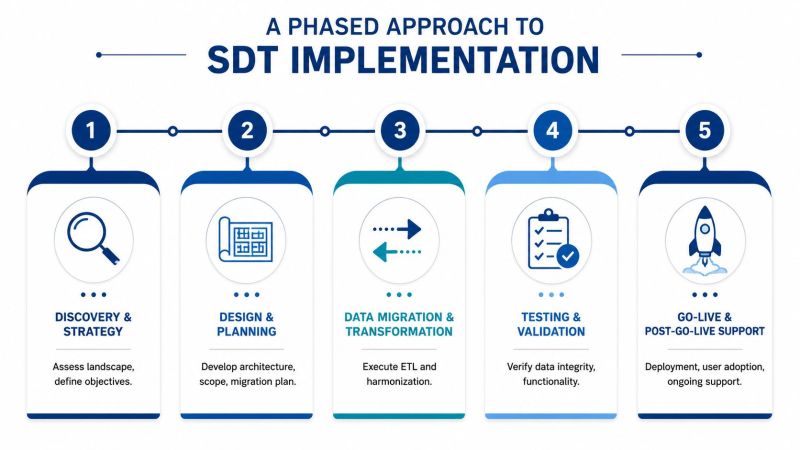
A selective data transition works best when the team treats it as a program, not a set of isolated tasks. The work needs a clear sequence, from scope control to build, then repeated validation before cutover starts. SAP's HCM guidance supports that discipline, since organizations often need to fit long data histories into a modern target while keeping delivery realistic, and SDT projects commonly stretch across 9 to 12 months when integrated with ERP, or 6 to 9 months when standalone.
Discovery and strategy first
A strong SDT program starts with a business decision, not a technical shortcut. Leaders need to define what the new environment must support, which records carry business value, and which legacy data can stay behind. If the organization cannot explain why a record set matters, it should stay out of the default scope.
The most useful discovery sessions are the ones that force trade-offs onto the table early. Finance may want longer history, HR may care about employee continuity, and operations may prioritize process continuity over archive depth. Those priorities need one accountable decision owner, or scope turns into delay.
Design and build with the target in mind
The design phase is where transformation rules are fixed. Mapping assumptions, target structures, and load logic all need to be settled before the heavy lifting starts. A solid build does more than copy configuration, it creates a controlled foundation for the data that will enter S/4HANA.
This is also where delivery discipline matters. Kagool's Build Factory Model and IT Cloud Global's AWS migration insights both point to the same practical lesson, repeatable methods reduce avoidable variation. In an SDT program, that means the team can separate design decisions from execution noise and keep each workstream accountable for its own output.
Testing, cutover, and support need their own discipline
Testing has to use realistic data subsets and repeated reconciliation. Cutover needs a rehearsed sequence with clear ownership, because selective moves expose timing issues that a full-copy migration can hide. Post-go-live support is part of delivery, not a courtesy period, since users quickly surface edge cases in reporting, authorization, and historical lookups once they start working in the new system.
A phased approach also gives the team room to inspect what the migration platform is doing at each stage. That matters more than it sounds. If the process only works in a single final run, the project has too little visibility into where the actual risk sits.
Kagool's Build Factory Model fits well here because it imposes rhythm on the work. That matters when multiple teams are touching scoping, mapping, load validation, and business testing at the same time. A structured delivery model will not make the project easy, but it does make it governable.
Overcoming Common SDT Challenges
SDT creates room for better outcomes, but it also exposes problems that a full-copy migration can hide. The first failure mode is data scoping complexity. Business units often disagree on what history to keep, especially when finance, HR, and operations each have different retention needs. Once scope becomes a negotiation without a decision owner, the project loses momentum.
Another common issue is latent data quality. Selective migration forces bad master data, duplicate records, and unclear dependencies into the light. That's not a defect in the method, it's the method doing its job. The risk is that teams underestimate how much cleansing and rule definition is needed before load.
The final two risks are cutover pressure and validation scale. A selective move can still create downtime if the team hasn't rehearsed the sequence. Validation can also become a swamp if it depends on manual reconciliation across too many objects.
What works when projects start to wobble
A strong mitigation pattern starts with tighter decision rights. The business needs one accountable owner for scope, and IT needs one accountable owner for transformation rules. Without that, every exception becomes a debate.
Automated validation is the next control. Tools that generate reconciliation evidence reduce the chance that teams miss a mismatch buried in the load results. That's where Kagool's Pulse is relevant, because it's designed to automate migration planning, execution, and validation in a way that aligns with the demands of SDT.
The hidden risk is usually dependency management
The hardest issues are often not the obvious data errors. They're the dependencies between object types, especially when historical items, balances, and master data have to line up in the target. If one object is cleansed without respecting the others, the target system may technically load but still fail in business use.
For a broader lens on the recurring pitfalls, Kagool's data migration challenges overview is a practical reference. The key point is simple, SDT demands traceability from scope definition all the way through reconciliation.
Practical rule: don't let the team treat validation as a final checkpoint. In SDT, validation is part of design.
Your Enterprise Checklist for a Successful SDT
A successful SDT program starts with a clear business case, not a tool purchase. If executives can't explain why selective history, process continuity, or IT system consolidation matters, the team will keep revisiting the same arguments halfway through the project. The best programs treat SDT as a transformation decision with measurable business outcomes.

The checklist that should be on the wall
- Define clear business objectives. Be explicit about why the enterprise is changing, whether that's consolidation, simplification, or selective history retention.
- Assemble a dedicated SDT team. Bring together business owners, SAP architects, data specialists, and testing leads early.
- Conduct a data environment assessment. Identify what must move, what can be cleaned, and what should stay behind.
- Select the right tools and accelerators. Match SAP-native capabilities with migration, validation, and governance tooling.
- Develop a thorough testing strategy. Plan for repeated validation, reconciliation, and business scenario testing.
- Plan for change management. Users need to understand what history, processes, and reports will look like after go-live.
- Establish success metrics and KPIs. Decide in advance how the program will measure data quality, scope discipline, and business readiness.
What senior teams should look for in a partner
A partner should be able to connect method, tooling, and governance without forcing the client to stitch the work together alone. Kagool's SAP delivery capability, including Pulse for migration execution and validation, and the Build Factory Model for repeatable delivery, fits that requirement when SDT is part of a larger S/4HANA program. If your organization is already comparing transformation patterns, IT Cloud Global's AWS migration insights are also a helpful reminder that cloud moves succeed when planning, sequencing, and validation are treated as first-class disciplines.
The enterprise checklist is simple, but it isn't easy. If the business case is clear, the scope is disciplined, and the validation model is automated, SDT becomes a practical way to modernize without losing operational truth. If those pieces are missing, the project drifts back toward the extremes SDT was meant to avoid.
Kagool helps enterprises plan and deliver SAP data migration programs with a practical mix of advisory, accelerators, and governed execution. If you're weighing selective data transition for your S/4HANA roadmap, visit Kagool to explore how Pulse, Velocity, and the Build Factory Model can support a controlled move from legacy complexity to a cleaner target environment.

