

You're already past the “should we use Microsoft?” question. The problem is messier, your Azure spend keeps climbing, Fabric is half in place, Power BI numbers don't line up, and the team you hoped would steady the rollout is buried under tickets, handoffs, and conflicting priorities. At that point, the winner usually isn't the prettiest tool demo, it's the partner that can turn Microsoft data sprawl into a working operating model.
Table of Contents
- The Moment You Realize You Need a Microsoft Partner for Data Analytics
- What a Microsoft Data Analytics Partner Actually Does
- The Certifications and Awards That Actually Matter
- Delivery Models, Scale, and the Operating Model Behind the Logo
- Two Real-World Examples of Partners in Action
- How to Pick the Right Microsoft Partner for Your Project
- Common Mistakes When Choosing a Microsoft Analytics Partner
- Key Takeaways and Your Next Step
The Moment You Realize You Need a Microsoft Partner for Data Analytics
The trigger is usually ugly and familiar. One team says the KPI is fine, another says it's wrong. The data platform team says the source is unstable, the business says the dashboard is late, and leadership wants a simple answer by Friday.
That's when the question changes. It stops being which Microsoft tool should we buy next and becomes which team can we trust to deliver an outcome without making the estate harder to run.
Microsoft's own partner analytics stack makes that distinction obvious. The Partner Center Insights workspace gives partners a unified view across cloud products like Microsoft Office, Azure, and Dynamics 365, plus licensing models such as CSP and EA, with metrics including customer count, active subscriptions count, Azure consumption revenue, active licenses, and workload views for Power BI, Dynamics 365, EMS, and Teams Microsoft Partner Center Insights overview. That tells you Microsoft expects partner performance to be measured across the whole operating estate, not by one isolated dashboard.
Practical rule: If a partner can't explain how it measures adoption, consumption, and reporting quality across the estate, it probably doesn't know how to run the estate either.
The rest of the decision follows from that. You're not buying a slide deck, and you're not buying licenses. You're buying a team that can design, build, govern, and operate Microsoft data work in a way your business can live with after go-live. That matters more than a shiny product list because the wrong partner will turn even a strong platform into a pile of disconnected reports and deferred decisions.
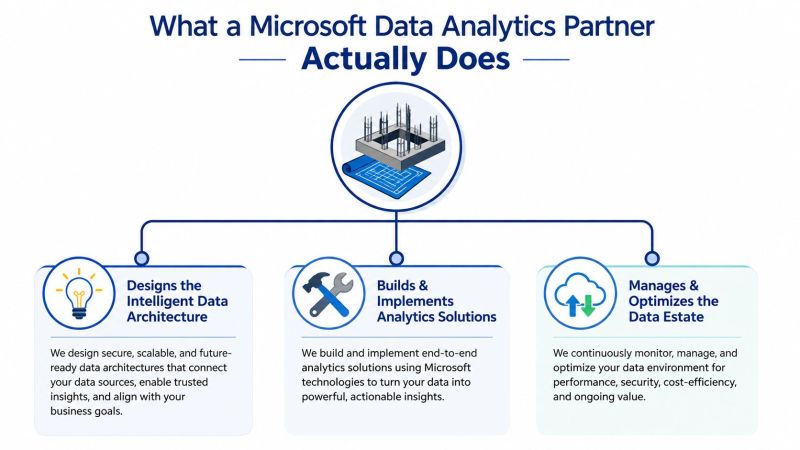
What a Microsoft Data Analytics Partner Actually Does
Think of a real partner as a building contractor for your data estate, not a software reseller. A reseller hands over materials. A contractor reads the site, draws the plan, coordinates the trades, and makes sure the building doesn't crack six months later.
The work starts with architecture
A serious partner defines the target platform before it writes a single pipeline. That means deciding how data lands, how it's transformed, where the semantic layer lives, what belongs in Power BI versus Fabric, and how governance is enforced from day one. Microsoft's partner analytics stack already points in that direction, because the Insights workspace gives access to KPIs and analytics reports across multiple workloads, and it also supports programmatic APIs for insights data Microsoft Partner Center Insights overview.
Then comes engineering and BI
The partner builds ingestion, transformation, and model layers that the business can use. It tunes the semantic model, wires up dashboards, and makes sure the reporting layer doesn't become a second source of truth. If your team is still stitching data from email attachments or copy-pasted exports, a partner should replace that with repeatable ingestion and governed reporting.
A practical example is document-driven operational data. If your team needs to automate document data into SQL Server, that usually sits inside the wider ingestion design, not as a one-off script. The right partner makes that kind of flow part of the platform, so it can be monitored, tested, and reused.
Governance and managed service are not optional extras
Good partners also handle security, lineage, access control, and operational support. They don't treat governance as a workshop slide. They build it into the delivery, then stay around to keep the environment healthy after launch. That's the difference between shipping a dashboard and running a data estate.
If you need a reference for how one provider frames that broader lifecycle, Kagool describes Microsoft Fabric, Power BI, and managed data services as part of its delivery model, which is the right category to evaluate rather than a point-product pitch. The useful question is whether the partner can hand over something your own team can own later, not whether it can decorate a proposal.
A partner should reduce the number of moving parts your team has to babysit, not add another layer of custom logic nobody understands.
The Certifications and Awards That Actually Matter
Badges are noisy, but not all badges are equal. In Microsoft land, the useful signal is not “does this company have a logo on its website.” It's “can this company prove it has the people, workload experience, and audit trail to deliver on a real engagement.”
Read the qualification stack, not the marketing banner
Microsoft's Analytics on Azure specialization is the clearest hard gate in the material provided. Partners must show at least USD 9,000 in eligible Azure Consumed Revenue over the prior three months, maintain at least five certified individuals with the required analytics credentials, and pass a third-party audit or validated customer-reference review Microsoft Analytics on Azure specialization requirements. That matters because it ties credibility to workload execution, certified delivery depth, and proven architecture, not just sales motion.
Certified people matter more than headcount
Buyers get fooled. A large firm with a broad bench isn't automatically strong if only a tiny slice of that bench is certified in the workload you care about. You want to know who holds the credentials, who will staff your project, and whether those people have shipped production work in Microsoft data environments. A partner with five capable specialists beats a partner with a hundred generic resumes every time.
Awards are signals, not guarantees
Microsoft partner awards can help, but only as context. Kagool's 2024 Microsoft Partner of the Year recognition is useful as a directional signal, because it suggests Microsoft saw validated delivery success in the ecosystem. Still, a trophy doesn't replace relevance. If your project is Fabric-heavy, you still need the exact workload fit, the named team, and evidence of similar delivery.
For a deeper view of how a category-recognized partner frames its Microsoft standing, see this overview of the company's award positioning: Kagool and Microsoft partner recognition in 2024.

Decision rule: If the partner can't name the certified people who'll do the work, the badge probably won't save the project.
Delivery Models, Scale, and the Operating Model Behind the Logo
A partner can be technically qualified and still fail in the actual world. The failure usually comes from the operating model, not the Microsoft badge.
Delivery scale only matters if it is structured
Look at how the practice runs. Serious analytics firms split delivery across onshore, nearshore, and offshore teams so they can balance expertise, speed, and coverage. They use accelerators for repeatable tasks, not because they're flashy, but because they reduce avoidable rework. They also keep a managed-services motion after go-live, because most data platforms don't fail at launch, they fail in the months after everyone assumes the job is done.
Microsoft's own partner analytics direction reinforces that operating mindset. The partner insights APIs expose datasets, report queries, scheduled report execution, and execution history, which makes automation and repeatable monitoring part of the platform rather than a side project Microsoft partner programmatic analytics API. In practice, that's the same pattern strong partners should use internally.
The best partners run on the same stack they sell
This is the simplest quality check in the market. If a partner sells Fabric, Power BI, and governed data operations, it should be able to show you how it uses similar tooling to manage its own delivery and reporting. If it can't, you're probably looking at a sales organization with delivery attached, not a delivery organization with a sales function.
That's also why the Microsoft Fabric adoption conversation matters. Partners that have real operating discipline don't treat Fabric as a buzzword. They use it as part of a broader architectural posture, and they can explain how adoption changes their data engineering, reporting, and support model. Kagool's Fabric adoption framework is one place a buyer can review that kind of thinking before entering procurement: Kagool's Microsoft Fabric adoption framework.
If the partner's own analytics environment looks like a mess, don't expect your environment to come out cleaner.
The strongest delivery teams also show you how they handle project recovery, handoff, and support. That's where Build Factory style methods, reusable components, and managed services become meaningful. They're not just ways to go faster. They're how the partner makes quality repeatable across multiple workstreams and geographies.
Two Real-World Examples of Partners in Action
The easiest way to spot a strong Microsoft analytics partner is to look at how it handles ugly, ordinary problems. Fancy demos don't matter when the source systems are messy and the business needs one version of the truth.
SAP data that keeps breaking the integration layer
In one common scenario, a company runs SAP on one side and Azure analytics on the other, but the integration path is fragile. Custom ETL breaks when the source changes, teams keep rewriting logic, and every fix creates more rework than the last. The partner response should be boring in the best possible way, a repeatable ingestion pattern that removes manual glue and gives the business a stable pipeline.
That's where Kagool's Velocity for SAP-to-Azure no-code data ingestion fits the picture. It's the kind of accelerator that matters because it trades brittle custom scripts for a structured ingestion flow. The primary gain isn't just speed, it's less rework and fewer late-stage surprises when the source environment shifts.
BI sprawl that turned into political debt
The second scenario is more familiar to business users. Tableau, Qlik, and legacy reports all coexist, nobody trusts the same dashboard, and every department defends its own version of the metric. The partner has to consolidate the mess without breaking the business. That usually means mapping the semantic layer, migrating the reporting estate in phases, and setting governance so the new platform doesn't recreate the old chaos.
A partner with a structured Tableau to Power BI migration accelerator can make that transition less risky, but only if it also brings governance and adoption support. Kagool's migration approach is relevant here because it pairs Fabric and Power BI delivery with structured transition work, which is exactly what multi-tool estates need. If the partner treats migration as a lift-and-shift exercise, the sprawl just reappears under a different logo.
For another example of how a partner positions itself in the Microsoft ecosystem, Kagool also publishes its recognition as a top data and AI partner here: Microsoft data and AI partner recognition.
The common lesson is simple. The right partner doesn't start by showing you its tool inventory. It starts by showing you how it will remove fragility from your current operating model and leave you with something cleaner than what you had before.
How to Pick the Right Microsoft Partner for Your Project
Start with the workload, not the brand. If you need Fabric modernization, ask for Fabric delivery. If you need Azure analytics, ask for Azure analytics work. If you need governance and managed operations, ask to see that motion, not a generic consulting brochure.
Here's the shortlist I'd use in procurement:
- Check the exact specialization: Ask whether the partner holds the certification or specialization that matches your workload, not just a broad Microsoft badge.
- Name the actual team: Get the specific certified people who will staff discovery, build, and handoff. If the answer stays abstract, keep walking.
- Demand a live demo on your data: A canned demo proves the vendor can script a deck. It doesn't prove it can solve your problem.
- Inspect governance and security design: Ask how lineage, access, and operating controls are built into the solution.
- Require a handoff plan: If the partner can't describe what month nine looks like, it's not designing for your long-term success.
- Ask for reference customers in your industry: The relevant proof is close to your own operating reality, not just “big-company experience.”
Pricing should match the risk profile. Fixed scope works when the use case is narrow and defined. Time and materials fits discovery-heavy or changing work. Managed services retainer makes sense when the estate needs ongoing oversight, because that's where the value keeps accruing after launch.
Best question to ask first: “Show me your own internal analytics stack, who specifically will be on my project, and what does handoff to our team look like at month nine?”
If you want a partner option that offers Microsoft Fabric, Power BI, SAP integration, and managed data services in one portfolio, Kagool is one name to evaluate alongside others. If that mix matches your roadmap, you should still run the same tests above before you commit. You can also compare collaboration models by reviewing a vendor's partner ecosystem entry point, such as GoSafe's invitation to join the partner program, but keep your buying criteria rooted in delivery proof, not partner marketing.
Common Mistakes When Choosing a Microsoft Analytics Partner
The bad choices are predictable. That's good news, because it means you can avoid them early.

- Choosing based on logo size alone. A big brand can still put a junior, generic team on your work. The better move is to verify the exact workload experience and named delivery staff.
- Ignoring relevant certifications. A broad Microsoft relationship doesn't prove analytics depth. Ask for the specialization that matches your stack and the people who earned it.
- Treating the partner like a license reseller. Licenses don't solve broken governance or inconsistent metrics. You need architecture, engineering, and operating support, not just procurement help.
- Postponing handoff questions. If no one can explain the support model after go-live, the business ends up owning risk it didn't budget for.
- Assuming offshore is automatically cheaper. Cost only falls if time-zone coverage, communication, and delivery discipline are in place.
The better default is obvious. Verify specialization, inspect the operating model, and ask how the partner will support the estate after implementation. If it can't answer those questions cleanly, it's not ready for a serious Microsoft analytics engagement.
Key Takeaways and Your Next Step
The partners worth hiring usually share three traits. They have the right Microsoft qualification for the workload, they run an operating model that matches the stack they sell, and they bring accelerators, governance, and managed services instead of pure custom build.
That's the filter. The strongest microsoft partner data analytics decision isn't about picking the flashiest platform or the biggest logo. It's about choosing a team that can make your Microsoft estate measurable, governed, and usable after the launch meeting ends.
Take one next step this week. Ask your shortlist for a discovery workshop, a live demo on your data, and the names of the certified people who would deliver the work. If they can't answer those questions plainly, they're not ready.
Kagool helps organizations design and implement Microsoft data and analytics platforms, including Fabric, Power BI, SAP integration, and managed services. If you need a partner that can turn a fragmented Microsoft estate into a governed operating model, start a conversation with Kagool and pressure-test your roadmap against real delivery experience.

